

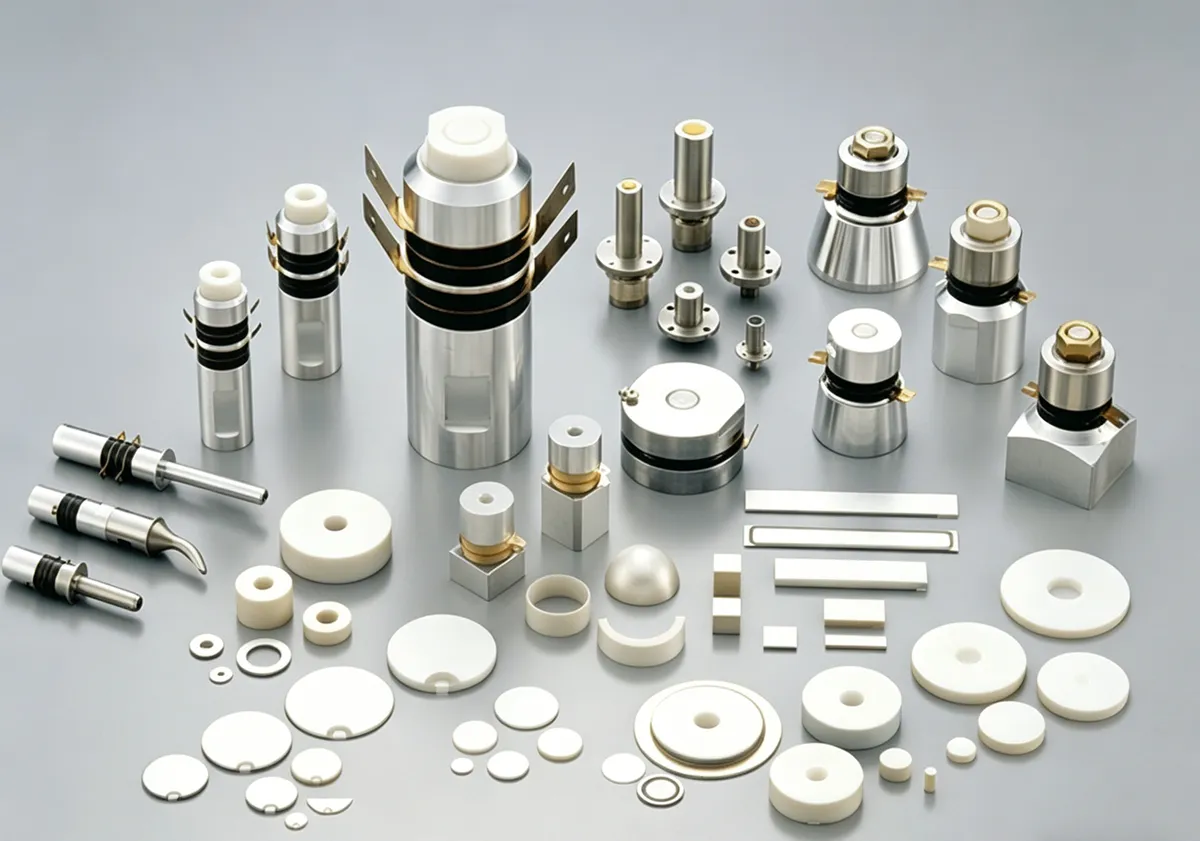
Heat causes piezoelectric ceramics to lose polarization when thermal exposure disrupts the aligned ferroelectric domains that produce their useful piezoelectric response. Permanent performance loss can begin below the Curie temperature. The relevant limit is the temperature and exposure duration qualified for the specific material and component under its electrical and mechanical operating conditions.
For an ultrasonic transducer or ceramic sensor, the practical question is whether the ceramic itself has exceeded that qualified thermal envelope. A housing temperature, liquid temperature, or published Curie point cannot answer this alone. Internal heating, mounting stress, drive amplitude, and repeated exposure all affect the margin available before sensitivity, displacement, or acoustic output suffers.
The Curie temperature is a boundary, not an operating rating
Common ferroelectric piezoelectric ceramics, including lead zirconate titanate (PZT), acquire their working polarization through poling. A strong electric field aligns domains within the material, leaving a net polarization after the field is removed. This alignment allows an applied voltage to produce motion and mechanical loading to generate electrical charge.
At the Curie transition, the material loses its ferroelectric order. Heating through this transition destroys the previously established domain alignment. Cooling below the transition restores the ferroelectric phase, but does not reliably restore the original macroscopic polarization. Recovering the intended response generally requires a controlled repoling process.
Below that transition, domain alignment can still become less stable. Heat promotes domain rearrangement, while electrical fields and mechanical stresses influence which domain orientations remain favorable. Partial thermal depolarization therefore does not require the entire ceramic to reach its Curie temperature.
This distinction explains why a material datasheet can show a Curie temperature substantially above its recommended service temperature. The service rating accounts for acceptable performance retention under specified conditions. The Curie value describes a material transition; it does not establish how long a finished transducer can operate safely near that transition.
There is no universal temperature at which all piezoelectric ceramics begin losing useful polarization. Rules based on a fixed fraction of the Curie temperature are screening heuristics, not acceptance criteria. They cannot replace grade-specific thermal data, especially for continuously driven power transducers.
Reading temperature specifications without confusing their meaning
Several temperature values can appear in component documentation. Their names look similar, but they answer different questions. A usable limit needs both a temperature and a defined exposure condition.
A brief assembly excursion and continuous operation at the same nominal temperature are different exposures. A soldering limit also does not automatically authorize oven heating of the complete component: local lead heating and uniform heating of the ceramic create different temperature histories.
When documentation gives only a maximum temperature, obtain its definition before using it as a shutdown setting. Useful clarification includes the exposure duration, energized or unenergized condition, allowed change in piezoelectric properties, and whether the rating applies to the bare ceramic or the assembled device.
Why exposure time and drive conditions change the answer
Thermal depolarization is influenced by both temperature and time. An exposure that leaves little measurable change during a short test can produce greater permanent loss over an extended dwell. Repeated excursions also deserve attention; returning to room temperature between cycles does not necessarily restore domain alignment lost during earlier heating.
Material formulation changes this behavior. Acceptor-doped “hard” PZT grades are often selected for high-power resonant applications because their lower losses and more strongly constrained domain motion suit those conditions. “Soft” grades often provide higher piezoelectric response, but their losses and domain mobility require a different assessment. These labels alone do not establish a safe temperature, and Curie temperature varies with formulation.
During powered operation, an alternating electric field produces dielectric losses, while vibration produces mechanical losses. Both generate heat inside the transducer. High drive amplitude, unsuitable loading, or operation away from the intended resonance can increase temperature even when the surrounding air or process liquid remains relatively cool.
The electrical field also matters independently of heating. A field opposing the poling direction can destabilize polarization if it exceeds the material’s allowable conditions. Since resistance to polarization reversal changes with temperature, a drive waveform tolerated when cold may be unsuitable when hot. Thermal qualification therefore needs the intended voltage waveform and field across the ceramic, not just the generator’s nominal power setting.
Mechanical preload and mounting stress further affect the response. In a bolted ultrasonic stack, differential expansion changes the force acting on the ceramic rings. Incorrect preload, uneven contact, or rapid temperature gradients can introduce excessive stress. Resulting cracks or contact problems produce performance loss that can resemble depolarization, even when polarization is largely retained.
The temperature that matters is inside the ceramic assembly
A sensor on the metal housing measures the housing at its attachment point. Its reading may lag behind the hottest ceramic region during startup, sustained high-power operation, or an abrupt load change. A low surface reading is therefore insufficient evidence that the active material remains within its limit.
In ultrasonic cleaning equipment, the bath heater and the energized transducer both contribute to temperature. A bond layer between the ceramic assembly and tank also affects heat transfer. Its temperature rating can become the limiting constraint before the ceramic reaches its thermal depolarization limit.
Ultrasonic welding presents a different pattern: short high-power bursts followed by cooling intervals. A low average duty cycle can conceal a high local peak, while frequent cycles can prevent full cooling. Temperature assessment should cover the production sequence that creates the greatest heat accumulation, including the installed tooling and load.
For sensors exposed to a hot process, thermal conduction through the mounting point can dominate. A cooler cable connection or exterior enclosure does not establish the sensing element’s temperature. Hot-soak testing must allow enough time for the internal assembly to approach its sustained operating condition.
Where direct ceramic measurement is impractical, establish the relationship between an accessible sensor location and the internal temperature through a representative thermal test. Include transient behavior and measurement uncertainty when setting alarms. Infrared measurements also require care: electrode and metal surfaces can give misleading readings unless emissivity and viewing conditions are addressed.
Separating thermal drift from permanent depolarization
Reduced output while a device is hot does not prove that it has permanently lost polarization. Temperature changes elastic properties, dielectric behavior, resonance frequency, and mechanical coupling. These changes can alter displacement, sensor response, or acoustic output even when the component recovers after cooling.
For a resonant transducer, a generator operating at a fixed frequency may deliver less useful vibration as resonance shifts. Reduced output then reflects the interaction between temperature and drive frequency. A frequency-tracking generator addresses detuning within its operating capability, but tracking alone does not establish that the ceramic remains thermally safe.
Persistent loss after cooling is a stronger indication of irreversible damage. Compare the cooled device with its earlier baseline at the same temperature, mounting condition, preload, and measurement settings. Allow thermal stabilization before drawing conclusions; a warm internal stack can continue changing after the exterior feels cool.
Useful measurements include a piezoelectric coefficient appropriate to the poling direction, sensor sensitivity under a defined stimulus, displacement at a controlled field, and impedance or resonance characteristics. Together they provide a clearer picture than an isolated capacitance reading. Capacitance changes with temperature and assembly condition, so it cannot reliably establish polarization retention by itself.
Permanent output loss still has several possible causes. Cracked ceramics, damaged electrodes, loosened fasteners, degraded adhesive, and altered acoustic coupling all deserve inspection. Depolarization becomes a stronger diagnosis when the relevant piezoelectric response remains reduced after cooling and other assembly faults have been excluded.
Handling an overheating event without losing diagnostic evidence
When temperature exceeds the qualified limit or output falls unexpectedly alongside rapid heating, remove the drive and record the event before repeated restarts change the evidence. Capture the temperature trace, exposure duration, voltage or power settings, frequency behavior, load condition, and cooling status. The hottest observed temperature alone cannot describe the event.
- Allow controlled cooling according to the equipment’s service procedure. Abrupt quenching can introduce thermal gradients and damage the ceramic, bonds, or joints.
- With the assembly isolated, examine accessible connections, fasteners, bond areas, and ceramic surfaces for physical damage. Follow the electrical discharge procedure before contact with terminals.
- Measure the cooled assembly under repeatable conditions and compare it with its baseline or an equivalent verified component. Begin with low excitation where the diagnostic method allows it.
- If performance remains outside acceptance limits, resolve the material condition and assembly faults before returning to full drive. Increasing voltage to compensate for lost output adds heat and can aggravate the failure.
Simply cooling a thermally depolarized component does not reliably restore its original response. Repoling requires a qualified electric field, temperature, duration, and electrode arrangement. A finished transducer may contain bonds, insulation, or hardware that prevent safe repoling, and repoling cannot repair cracks or damaged interfaces.
Turning a material limit into a usable operating limit
A practical shutdown threshold should sit below the component’s qualified limit by a margin that accounts for sensor error, internal temperature gradients, and control-system delay. That margin needs evidence from the installed assembly. An arbitrary offset from the Curie temperature leaves these operating uncertainties unresolved.
The qualification record should identify the ceramic grade, component construction, temperature measurement point, electrical drive, mechanical loading, and duration of exposure. It should also define the acceptable permanent change after cooling. Without a retention criterion, a statement that a component “withstood heat” says little about whether it preserved enough sensitivity or displacement for the application.
Where a published standard or test method is specified, establish whether it addresses material characterization, assembly testing, or performance retention after thermal exposure. A room-temperature property measurement does not establish a high-temperature endurance rating. The applicable acceptance requirement must connect the test conditions to the intended service conditions.
After changes to tooling, mounting, cooling, drive settings, or duty cycle, repeat the relevant thermal assessment. Such changes can move the hottest region or increase the delay between internal heating and the alarm sensor’s response. The temperature limit becomes operationally meaningful only when the installed measurement and control arrangement keeps the ceramic within its qualified exposure conditions.

Thank you very much for writing to us. Please leave your message and contact information, we will reply to you within 24 hours.