

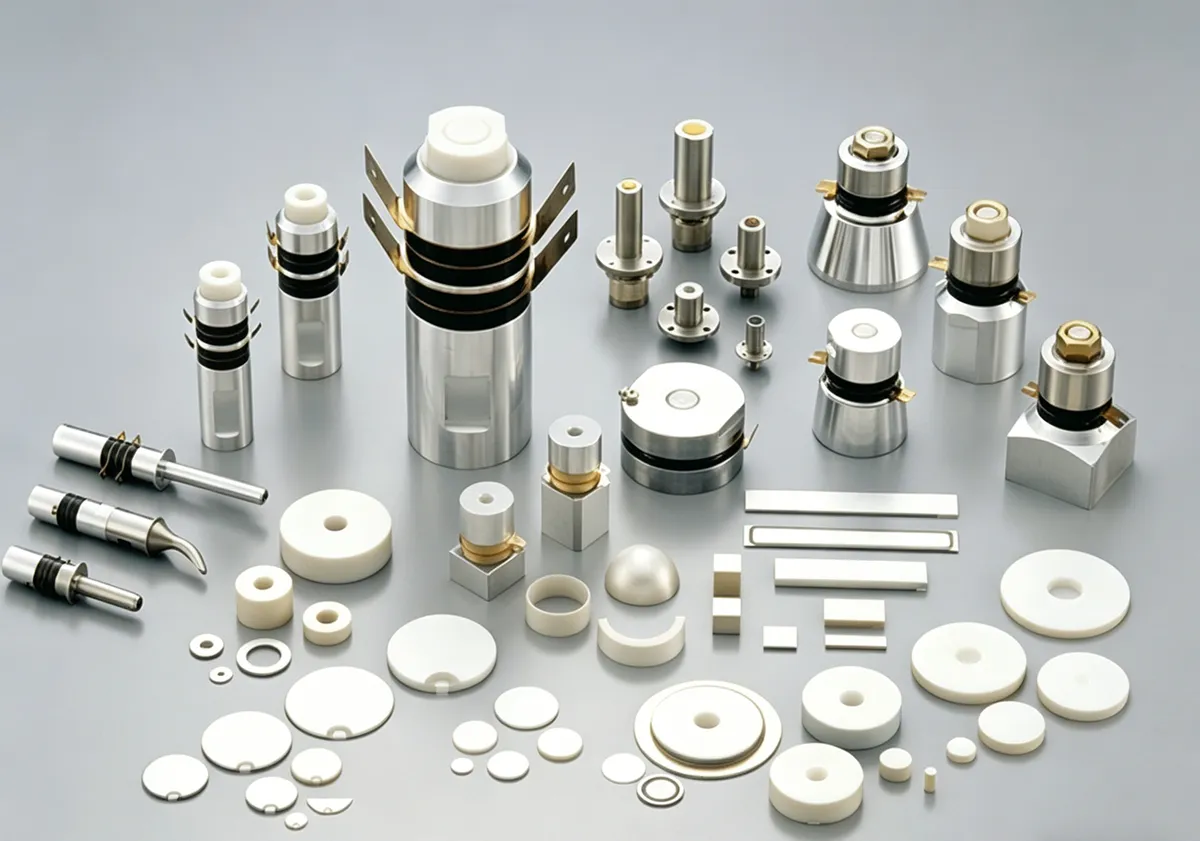
Bonding Piezoelectric Ceramic Components securely is only half the job. The joint must also accommodate—or correctly transfer—the movement your application needs. A component that performs well before assembly may lose displacement, shift resonance, or generate more heat after bonding. Often, the ceramic is not defective: the adhesive or mounting arrangement has changed its mechanical behavior.
For operators assembling sensors, actuators, and ultrasonic devices, the practical question is not simply “Which glue holds best?” It is “Where should this component be attached, and what must the joint allow it to do?” A reliable solution starts with the intended vibration mode, then matches the attachment area, adhesive properties, and curing process to that motion.
Decide what must move—and what must stay coupled
“Without limiting motion” does not mean leaving every surface free. Some piezoelectric devices need a rigid connection to transfer force or acoustic energy. Others need a flexible section to bend without interference. The goal is to avoid unwanted restraint while preserving the mechanical coupling the device requires.
Before applying adhesive, identify the active surfaces, electrical connections, mounting locations, and expected direction of displacement. Use the component drawing or assembly specification rather than assuming that a convenient flat surface is a suitable bonding area.
For resonant components, a support near a suitable vibration node may reduce disturbance. However, nodal locations depend on geometry, operating mode, and the assembled load. A low-displacement location can still experience substantial stress, so “bond at the node” is not a complete instruction. Confirm the mounting arrangement with the supplier or a validated design.
Choose adhesive by its mechanical role, not just bond strength
The strongest adhesive is not automatically the best adhesive for piezoelectric ceramic bonding. Relevant properties include cured stiffness, damping, cure shrinkage, temperature capability, electrical behavior, and adhesion to the actual surfaces. The ceramic may be metallized, meaning the joint depends on electrode adhesion as well as adhesive strength.
When a relatively stiff adhesive makes sense
A suitable epoxy is often considered where the joint must transmit force or ultrasonic vibration. A thin, uniform, relatively stiff bond can maintain coupling between the ceramic and its working structure. This may be appropriate for a sensor attached to a strain-carrying surface or an ultrasonic element coupled to another acoustic layer.
The trade-off is stress. Cure shrinkage and differences in thermal expansion between ceramic, adhesive, and substrate can create residual loads. A rigid joint over a large area may also constrain movement that the design needs. Review the adhesive’s cured properties at the operating temperature, not only its room-temperature strength.
When a compliant adhesive may help
Silicone or another compliant adhesive may suit certain supports, seals, or strain-relief features where accommodating differential movement matters more than transmitting force. It can reduce local stress in some assemblies, but its flexibility may introduce damping or permit unwanted movement.
That makes it unsuitable as a universal answer. A soft adhesive placed directly in an ultrasonic energy path can reduce output, while a strain sensor may respond poorly if the bond absorbs the deformation it should measure. Keep compliant support functions separate from active coupling surfaces where the design permits.
Fast-setting adhesives can simplify positioning, but speed alone is not a selection criterion. Check whether the proposed adhesive remains stable under vibration, humidity, temperature cycling, and repeated electrical operation. Conductive adhesive should be used only where the electrical design calls for it; it is not interchangeable with an insulating structural adhesive.
Control the bond line: thin, consistent, and appropriate
Bond-line thickness affects stiffness, stress distribution, and acoustic transmission. Too much adhesive can add mass, introduce damping, and spread into moving areas. An excessively thin or starved joint can leave discontinuities and fail to accommodate surface irregularities.
There is no universal thickness for all Piezoelectric Ceramic Components. The correct value depends on component geometry, adhesive formulation, substrate condition, frequency, and required coupling. Follow a qualified assembly specification where available. For a new design, establish thickness through controlled trials rather than relying on how the joint looks from the outside.
Operators can improve consistency with a defined dispensing volume, a controlled fixture gap, or compatible bond-line spacers approved for the application. Avoid adding arbitrary particles to an adhesive: they may interfere with electrical insulation, create stress concentrations, or alter acoustic behavior.
Do not use squeezing pressure as your only thickness control. Excessive force may damage a brittle ceramic, displace the adhesive unevenly, or starve part of the joint. A fixture should maintain alignment and gentle, distributed contact without forcing the component into a distorted shape.
Keep adhesive out of the movement envelope
A neat-looking fillet can still cause trouble. On a bending device, adhesive that creeps beyond the intended support effectively changes the active length. Around a diaphragm, an irregular bead can produce uneven restraint. In a compact housing, squeeze-out may bridge a clearance gap and contact a neighboring part.
Define both the bonding area and the keep-clear area before dispensing. The latter should account for operating displacement, assembly tolerances, thermal movement, and lead-wire routing. Clearance that exists at rest may disappear during operation.
Partial bonding is useful only when it fits the mechanical design. Small pads or separated attachment areas can reduce unwanted restraint, but they can also produce concentrated stress and uneven loading. Conversely, full-face bonding is not inherently wrong: it may be essential for acoustic transmission or strain transfer. Choose the coverage pattern from the required load path, not from a general preference for “less glue.”
A practical assembly sequence that protects performance
Inspect the component and mating surface. Check for chips, cracks, contamination, damaged electrodes, and substrate distortion. Verify orientation, polarization information, and electrode connections against the drawing.
Prepare surfaces using compatible methods. Remove oils and residues with an approved cleaner. Do not aggressively abrade thin metallization or use solvents without checking compatibility. Let surfaces dry fully before bonding, and avoid touching cleaned areas.
Apply the specified adhesive quantity. Use a repeatable dispensing method and the defined coverage pattern. With two-part systems, maintain the correct mix ratio and working time. Follow the adhesive manufacturer’s guidance for mixing and bubble control.
Position and fixture without bending the ceramic. Support the mating parts so assembly pressure is distributed appropriately. Verify that the fixture does not obstruct the active region or allow the component to drift during cure.
Cure within both adhesive and component limits. Check temperature, exposure time, and heating rate against supplier guidance. Excessive heat can damage electrodes, affect polarization, or stress the assembly. Being below a material’s Curie temperature does not by itself establish a safe curing process.
Inspect before electrical operation. Confirm clearance, electrode accessibility, lead strain relief, and the absence of unintended adhesive bridges. Allow the specified cure to finish before applying operational loads.
Lead wires deserve particular attention. A stiff wire pulled tightly across a vibrating surface can restrain motion even when the adhesive joint is correct. Provide suitable strain relief on the stationary structure and enough freedom at the connection to accommodate intended movement without repeated sharp bending.
During assembly and maintenance, disconnect the drive supply and follow the equipment’s discharge procedure before handling electrical connections. Piezoelectric elements can generate charge when mechanically loaded, and associated drive electronics may retain hazardous voltage.
Check the assembled device, not only the adhesive joint
A visual inspection cannot establish whether bonding has preserved performance. When developing or changing a process, compare representative components before and after assembly under documented conditions. The operating load, temperature, drive level, and fixture arrangement should be controlled so comparisons are meaningful.
For an actuator, check displacement or force in the intended configuration. For a sensor, assess sensitivity and repeatability using an appropriate reference input. For a resonant ultrasonic device, examine impedance behavior, operating resonance, output, and temperature rise.
Some resonance change is expected when a component is coupled to its intended structure. The question is whether the completed assembly meets its operating requirements—not whether it retains the exact free-component response. A large unexplained shift, substantial damping, or uneven output warrants investigation.
Change one process variable at a time during troubleshooting. Altering adhesive type, coverage, thickness, and curing conditions together makes it difficult to identify the real cause. Record the successful process so the next operator can reproduce it.
Bring the application details to your ceramic supplier
Weifang Jude Electronic Co. Ltd manufactures and supplies piezoelectric ceramics, ceramic sensors, ultrasonic piezo products, and power transducers for applications including ultrasonic cleaning and welding, fault detection, flow measurement, and underwater acoustics. These applications impose different bonding requirements; an attachment method suitable for a sensing element may not suit a power ultrasonic assembly.
When discussing a mounting solution, provide the component drawing, mating material, intended motion, operating frequency, drive conditions, temperature range, and exposure to liquids or cleaning chemicals. Ask about electrode handling, allowable curing conditions, and recommended attachment regions. These details give the supplier a useful basis for advice rather than forcing a choice from adhesive names alone.
The most reliable bond is not necessarily the largest or most rigid one. It is the joint that holds the component securely, transfers the required load, and leaves the intended movement intact. Define that mechanical job first, control the assembly process, and verify performance after curing. That is how a secure attachment becomes a dependable working device.

Thank you very much for writing to us. Please leave your message and contact information, we will reply to you within 24 hours.