

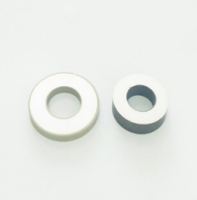
An ultrasonic transducer that performs well during a brief bench test may overheat under continuous operation, while a highly efficient resonant design may ring too long for accurate pulse-echo measurement. The choice between hard and soft Piezoelectric Ceramics can contribute to both problems. As a starting point, hard ceramics usually suit sustained, high-power resonant operation; soft ceramics often suit sensitive receiving, higher displacement at modest fields, and lower-drive transmission.
The distinction is not simply “power versus sensitivity.” Material selection must account for mechanical quality factor, dielectric loss, coupling, operating temperature, and the electrical and mechanical loads. A welding stack and an ultrasonic inspection probe may operate at similar frequencies yet require different ceramics because their duty cycles, acceptable ring-down times, and failure limits differ.
What “hard” and “soft” actually describe
In common lead zirconate titanate, or PZT, formulations, hard and soft refer primarily to ferroelectric behavior rather than physical hardness. Acceptor-doped hard PZT typically develops defect structures that restrict domain-wall motion. Donor-doped soft PZT generally allows greater domain-wall mobility, producing a stronger response to an applied field.
That difference creates a practical trade-off. Hard materials usually exhibit lower losses and higher mechanical quality factor, but lower piezoelectric coefficients. Soft materials commonly offer higher piezoelectric coefficients and permittivity, with greater losses and lower mechanical quality factor. These are family-level tendencies, not guaranteed specifications for every grade.
Hard ceramics can also show aging associated with domain stabilization. Temperature, strong excitation, and operating history may change their response. Soft materials often age less strongly, but that does not make them inherently suitable for high-field operation. Compare actual grades under defined test conditions rather than treating either label as a complete performance specification.
Read the datasheet in the transducer’s operating mode
A large d33 value is attractive, but it is not a universal ranking metric. A thickness-mode plate, a radial-mode disc, and a longitudinal stack use different combinations of material properties. For coupling, compare the coefficient relevant to the intended mode, such as kt, kp, or k33. A strong planar coupling coefficient does not establish superior thickness-mode performance.
The piezoelectric coefficient d describes strain per electric field or charge per applied force under specified conditions. The voltage coefficient g describes electric field generated per applied stress. Because g is related to d divided by dielectric permittivity, a material with higher d does not necessarily produce a higher open-circuit receiving voltage. Receiver impedance and cable capacitance further affect the measured signal.
Qm must also be interpreted carefully. It describes mechanical energy storage relative to loss for a specified resonant mode and measurement condition. High Qm is useful when a transducer must sustain resonant motion efficiently. It can also contribute to narrow response and extended ringing. However, ceramic Qm is not the loaded quality factor of the finished transducer: backing, bonding layers, acoustic radiation, preload, and the workpiece all contribute.
Most datasheet values are small-signal measurements. They are useful for screening materials and building initial models, but they may not predict behavior at high vibration velocity or electric field. Ask whether loss, resonance shift, and temperature data are available under conditions representative of the intended drive.
For welding and continuous cleaning, examine losses before sensitivity
In ultrasonic welding or sustained cleaning, the ceramic repeatedly converts electrical energy into mechanical motion while operating close to resonance. A soft grade may provide greater initial displacement at the same field, yet dissipate more energy as drive rises. Temperature increase can shift resonance, change impedance, and reduce the margin against depoling or mechanical damage.
Hard PZT is normally the stronger starting candidate for these conditions because of its lower losses and higher Qm. The benefit is not permission to apply unrestricted voltage. Allowable operation still depends on electric field, vibration amplitude, stress, temperature, duty cycle, cooling, and assembly design.
Electrical heating deserves a separate calculation. For a simplified capacitive element driven sinusoidally, dielectric power loss is approximately proportional to 2πfCVrms² tanδ, where f is frequency, C is capacitance, and tanδ is dielectric loss tangent. This estimate excludes mechanical losses and does not fully represent high-field nonlinear behavior. It nevertheless explains why frequency, capacitance, and voltage must accompany any loss comparison.
When evaluating two grades, compare them at the required useful output, not only at equal voltage. Different capacitance and electromechanical response can produce different output amplitudes and current demands. Record temperature rise, impedance, resonance movement, and delivered acoustic or mechanical output through the complete duty cycle.
Pulse-echo inspection makes ring-down a selection constraint
A flaw-detection probe must transmit a pulse and then receive a returning echo. Excessive ring-down can obscure early echoes and enlarge the near-surface dead zone. A ceramic chosen only for high resonant efficiency may therefore conflict with the measurement requirement.
Soft ceramics can be attractive because of their stronger piezoelectric response and generally lower Qm. Even so, broad bandwidth does not follow automatically from choosing soft PZT. Backing attenuation, matching layers, element thickness, aperture, cable loading, and pulser-receiver settings can dominate the finished response.
Evaluate pulse-echo sensitivity together with bandwidth, waveform duration, and the earliest detectable echo. A short pulse obtained through heavy damping may reduce sensitivity; recovering sensitivity through increased drive may introduce heating or field limitations. The relevant comparison is the complete acoustic stack with its intended electronics, not an isolated ceramic disc.
A dedicated receiver deserves a different assessment from a transmitting element. Charge sensitivity, voltage sensitivity, capacitance, amplifier noise, and input impedance determine the usable signal. Select the material around the readout architecture rather than assuming that the highest d coefficient always yields the best detection performance.
Mixed-duty applications need a closer comparison
Flow measurement, ranging, and underwater acoustics may combine transmission and reception in one element. Short bursts can keep average heating low, but peak electric field and peak mechanical stress remain important. Conversely, a nominally low-power device may accumulate heat if it operates frequently or has a poor thermal path.
For these designs, establish which constraint is hardest to satisfy. A strong transmit requirement with relatively tolerant receiving electronics may favor hard material. A sensitivity-limited receiver with modest transmit demand may favor soft material. If neither family clearly meets the combined requirements, compare specific grades and consider whether separate transmitting and receiving elements are practical.
Do not use Curie temperature as the operating limit
Curie temperature marks a phase transition, not a recommended continuous-use temperature. Loss of polarization or unacceptable property drift can occur below it, especially when temperature combines with electric field and stress. Soft and hard grades both require a supplier-supported operating envelope.
The temperature that matters is the ceramic temperature, which may exceed the temperature measured at the housing. Bond layers, electrodes, encapsulation, and mounting interfaces can restrict heat flow. A material with a favorable Curie temperature may still be unsuitable if its losses create excessive self-heating in the actual assembly.
For preloaded stacks, also verify the permitted mechanical loading. Compression can help prevent tensile loading during vibration, but excessive or uneven preload can damage ceramics or alter performance. Material selection cannot compensate for nonparallel interfaces, uneven contact, or an unsuitable preload arrangement.
A qualification sequence that exposes the trade-offs
Before requesting samples, define frequency and mode, required output, waveform, maximum drive, duty cycle, ambient conditions, and acceptable temperature rise. Include receiver requirements if the element performs both functions. Without those conditions, two suppliers can recommend different materials while each is optimizing for a different assumption.
- Screen comparable data. Request mode-specific coupling, relevant piezoelectric coefficients, permittivity, dielectric loss, Qm, Curie temperature, and recommended operating limits. Confirm measurement frequency, temperature, geometry, and tolerances.
- Measure the assembled low-drive response. Record capacitance, impedance spectrum, resonance and antiresonance, and unwanted nearby modes. Investigate assembly defects or modal interference before attributing a mismatch to the material family.
- Increase drive progressively under representative loading. Monitor ceramic temperature where feasible, current, real input power, output amplitude, and frequency shift. Use suitable limits for temperature, field, and stress.
- Run the intended duty cycle. Continue long enough to observe thermal stabilization or unacceptable drift. For pulsed operation, reproduce burst length and repetition rate rather than relying on average power alone.
- Recheck after cooling. Compare impedance and sensitivity with the initial measurements. Permanent changes may indicate depoling, cracking, bond deterioration, or another assembly problem requiring investigation.
Keep specimen geometry, electrodes, poling direction, mounting, and preload consistent when the objective is to isolate material effects. If the grades require different matching networks, document those changes. A fixed drive circuit can unintentionally favor one ceramic because its capacitance and impedance happen to fit the circuit better.
What to specify before approving a grade
A purchasing description such as “hard PZT ring” is insufficient for a repeatable transducer. Specify dimensions and tolerances, electrode configuration, polarization direction, relevant electrical properties, and the conditions under which those properties are measured. For resonant assemblies, frequency consistency and impedance variation may matter as much as nominal material constants.
Ask suppliers to distinguish measured values from typical values and recommended limits from absolute limits. Where sustained high drive is required, request available information on high-field loss, vibration behavior, aging, and temperature dependence. If such information is unavailable, leave those items for prototype qualification rather than inferring capability from Qm alone.
Approve the material against application-specific acceptance criteria: temperature stability and useful output for continuous resonant systems; pulse duration, bandwidth, and sensitivity for inspection probes; peak-drive capability and receive performance for burst-operated devices. Hard and soft labels narrow the search, but the finished transducer’s measured operating envelope determines whether a grade is suitable.

Thank you very much for writing to us. Please leave your message and contact information, we will reply to you within 24 hours.