

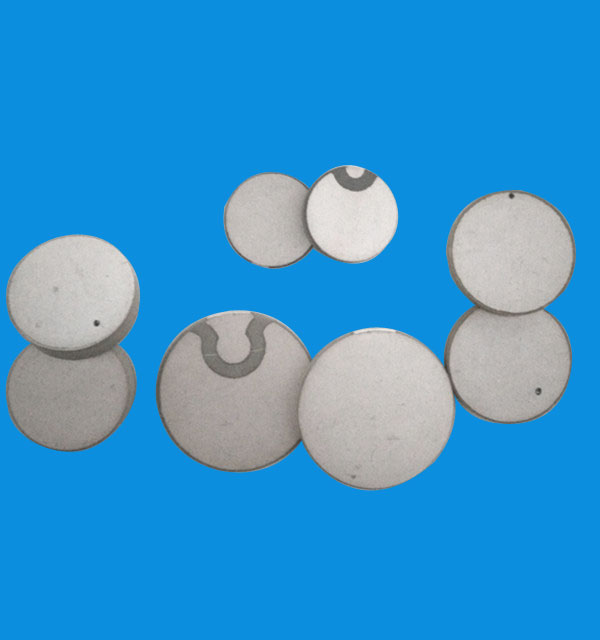
Selecting high power piezoelectric ceramic components for ultrasonic welding is rarely a purely technical purchase. For the people who run welding equipment every day, the choice shows up in much more practical ways: unstable welds, drifting amplitude, cracked stacks, overheating, inconsistent seam quality, and unplanned stoppages that are difficult to diagnose under production pressure.
In ultrasonic welding, the piezoelectric ceramic element is not a passive part hidden inside the transducer. It is the core conversion medium that turns electrical excitation into mechanical vibration. If that conversion is inefficient, unstable, or mismatched to the tooling and generator, the operator feels it immediately through lower process repeatability and narrower operating windows. That is why choosing high power piezoelectric ceramic components should be treated as a process decision, not just a component decision.
The most common mistake is to focus on rated power alone. A component may look acceptable on paper because its power figure appears high enough, yet still fail in real welding conditions because frequency matching is poor, heat resistance is inadequate, or dynamic loading exceeds what the ceramic stack can tolerate over long production cycles. For ultrasonic welding, the right question is not “What is the most powerful ceramic?” but “What ceramic configuration will remain stable in this specific welding system, under this duty cycle, with this material and tool setup?”
Why component choice affects weld quality more than many operators expect
Ultrasonic welding depends on controlled vibration at a defined frequency and amplitude. The piezoelectric ceramic stack inside the transducer must respond consistently while under preload, thermal stress, and repeated high-frequency excitation. Any weakness in the ceramic material or stack assembly tends to appear as process instability before it appears as total failure.
Operators often notice the early signs in production:
- weld strength varying from batch to batch;
- the machine requiring frequent retuning;
- unexpected temperature rise in the transducer area;
- reduced amplitude at the horn;
- higher reject rates on materials that were previously easy to weld.
These symptoms are not always caused by the ceramic itself, but low-quality or poorly matched piezoelectric elements are a frequent root cause. In high power applications, the ceramic must handle not only electrical input but also mechanical stress concentration and thermal accumulation. That is especially critical in continuous or near-continuous production environments.
Start with the welding application, not the component catalog
Ultrasonic welding covers a broad range of use conditions. Welding thin films or light plastic parts is very different from joining thicker thermoplastics, nonwoven materials, packaging laminates, or metal-related assemblies where energy demand and process sensitivity increase.
Before comparing suppliers or material grades, users should define the real operating conditions:
- working frequency of the welding system;
- required amplitude range;
- duty cycle and production rhythm;
- material being welded and its energy demand;
- ambient temperature and ventilation around the transducer;
- whether the equipment runs intermittently or in long continuous shifts.
A ceramic component that performs well in a laboratory demonstration can behave very differently in a factory running multiple shifts with variable loads. High power piezoelectric ceramic components should therefore be selected against the harshest realistic operating condition, not the average condition.
Frequency matching is usually more important than chasing maximum power
In ultrasonic welding, system resonance matters. The generator, transducer, booster, and horn must operate as a tuned system. If the ceramic stack is not properly designed for the target frequency, energy conversion becomes less efficient and heat generation rises. This can lead to amplitude loss, unstable welding energy, and accelerated fatigue.
Users should pay close attention to nominal operating frequency and tolerance. Common ultrasonic welding systems operate at frequencies such as 15 kHz, 20 kHz, 30 kHz, 35 kHz, or 40 kHz, but the actual selection depends on the process and tooling design. A ceramic stack intended for one frequency family should not be treated as interchangeable with another simply because the physical size seems adaptable.
What matters in practice is not just the nominal frequency value but frequency consistency under load. Some components test well without load but drift noticeably when the machine runs at production amplitude. That drift can reduce welding consistency and force the generator to work harder to maintain resonance.
For operators, this becomes a usability issue. A stable transducer assembly gives a wider and more forgiving process window. A marginally matched stack often feels “difficult” even if it technically runs.
Material quality determines how the ceramic behaves under stress
Not all piezoelectric ceramics are equally suitable for high power ultrasonic applications. Material formulation affects electromechanical coupling, dielectric loss, mechanical quality factor, aging behavior, and resistance to depolarization under heat and field stress. These are not abstract laboratory properties; they directly influence whether the transducer remains efficient and durable in real production.
For high power ultrasonic welding, users should be concerned with several practical performance traits:
- Low internal loss: reduces self-heating during high-power operation.
- Good mechanical strength: helps the ceramic survive preload and vibration stress.
- Stable piezoelectric properties over time: supports consistent weld quality.
- Thermal robustness: lowers the risk of performance drop when the transducer heats up.
- Resistance to depolarization: important when equipment operates near thermal or electrical limits.
Users do not need to become ceramic scientists, but they should ask whether the component was developed specifically for high power transducer use rather than adapted from general-purpose piezoelectric material. That distinction matters. Ceramics intended for sensing applications are selected for different priorities than ceramics intended for sustained ultrasonic power transmission.
Power handling should be evaluated as a system condition
“High power” is one of the most misunderstood terms in this field. A component’s power capacity cannot be judged only by a single number in a catalog because actual power handling depends on stack design, cooling conditions, preload, drive waveform, assembly quality, and how far the welding process pushes the transducer away from ideal resonance.
From a user perspective, the better approach is to ask:
- At what duty cycle was the component validated?
- Under what preload and clamping conditions was it tested?
- How does temperature rise behave during extended operation?
- What amplitude level can be sustained without rapid degradation?
- Is the stack intended for short bursts or for repetitive industrial cycles?
This matters because many field failures are not dramatic breakdowns at startup. They are progressive losses in efficiency caused by thermal accumulation and mechanical fatigue. By the time weld quality drops enough to trigger complaints, the transducer may already have been operating in a stressed state for weeks.
Reliability is not only about lifespan, but about process consistency
When users evaluate components, lifespan often gets reduced to a simple question: how long will it last? In production, however, a more useful question is: how long will it stay stable enough to support repeatable welding?
A component that survives for months but drifts steadily in amplitude or resonance can be more costly than one with a shorter but predictable service interval. In high-throughput lines, process variation can create hidden losses through scrap, rework, quality claims, and machine adjustment time.
That is why long-term reliability should include:
- frequency stability over repeated cycles;
- consistent output under rising temperature;
- resistance to cracking or chipping during assembly and operation;
- batch-to-batch consistency from the supplier;
- traceability when failures need investigation.
If a supplier cannot explain how consistency is controlled in production, users should be cautious. Piezoelectric ceramic performance can vary significantly if process control is weak, even when nominal specifications look similar.
Assembly quality can undermine a good ceramic
Even high-grade piezoelectric material will underperform if the transducer stack is poorly assembled. In ultrasonic welding, the ceramic discs are usually part of a clamped structure that includes electrodes, metal masses, bolts, and acoustic matching elements. Surface flatness, electrode quality, concentricity, insulation integrity, and preload accuracy all affect final behavior.
From the operator’s side, assembly-related issues often appear as intermittent or difficult-to-reproduce faults. One transducer runs normally while another from the same batch overheats or sounds different under load. In many cases, the root cause is not the ceramic formula itself but variation in stack assembly or poor mechanical integration.
For that reason, component selection should not stop at the ceramic disc level if the application uses complete transducer modules or assembled stacks. Users should understand whether they are buying raw elements, semi-finished stacks, or finished ultrasonic transducers, because the evaluation criteria differ.
Common selection mistakes in ultrasonic welding applications
Several recurring errors lead to disappointing performance.
One is assuming that higher amplitude always solves weak welds. If the ceramic stack is already near its safe operating limit, pushing amplitude further may increase heat and shorten service life without truly improving joint quality. The underlying issue may instead be horn design, fixture rigidity, or poor frequency matching.
Another is choosing based on purchase price alone. Lower-cost components can be attractive in maintenance budgets, but if they introduce tuning instability or shorter service intervals, the total operating cost rises quickly. In welding lines where downtime is expensive, reliability usually matters more than the initial unit price difference.
A third mistake is replacing a failed component with an apparently compatible alternative without checking resonance and stack design compatibility. Mechanical dimensions alone do not guarantee equivalent performance. In ultrasonic systems, small differences in material constants or assembly configuration can shift system behavior enough to create new problems.
There is also a tendency to overlook operating temperature. Heat is one of the main enemies of piezoelectric stability in high power service. If the equipment enclosure, airflow, or duty cycle causes heat buildup, even a correctly selected ceramic can degrade prematurely.
What users should ask suppliers before making a decision
For a practical evaluation, users should ask focused technical questions rather than broad claims about quality.
- Is the piezoelectric ceramic grade designed specifically for high power ultrasonic use?
- What frequency range and application type is it intended for?
- What operating limits are recommended for continuous or repetitive duty?
- How is batch consistency controlled?
- What failure modes are most common in field use?
- Can the supplier support matching with existing transducer and horn systems?
- What inspection or test data can be provided for shipped lots?
Useful suppliers usually answer in terms of operating conditions, not just nominal specifications. That is a good sign because it shows they understand the component in application, not only in isolation.
How to judge whether a component is suitable in real production
Bench testing matters, but production validation matters more. If possible, users should evaluate candidate high power piezoelectric ceramic components under realistic line conditions. Short tests at low duty do not reveal the most important risks.
A practical validation should observe:
- temperature rise during extended operation;
- amplitude stability over time;
- generator tuning behavior;
- weld strength consistency across repeated cycles;
- noise, abnormal vibration, or drift after thermal buildup;
- performance after startup-stop cycles common in normal production.
If a component performs well only when the machine is freshly started but degrades after prolonged use, that is a warning sign. High power ultrasonic welding is unforgiving to components that are only conditionally stable.
Choosing for fewer surprises, not just for nominal performance
The best component choice is usually the one that makes the welding process less sensitive, less variable, and easier to control shift after shift. For users and operators, that means prioritizing stable resonance behavior, thermal robustness, material quality, and assembly consistency over marketing claims or isolated performance numbers.
High power piezoelectric ceramic components are central to ultrasonic welding performance, but they should be evaluated in the context of the full acoustic system and the actual production environment. When users select on that basis, they are more likely to get stronger welds, lower rejection rates, fewer maintenance interruptions, and a process that remains dependable beyond the first installation.
In practice, the most valuable selection question is simple: will this component still behave predictably after thousands of cycles under my real operating load? That is the question that separates a workable part from a production-ready one.

Thank you very much for writing to us. Please leave your message and contact information, we will reply to you within 24 hours.