

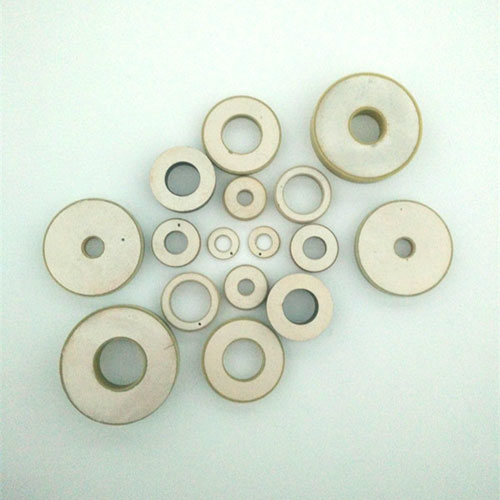
Where assembly complexity usually starts is not in the housing, but in the piezo stack
In ultrasonic equipment, sensing modules, and acoustic measurement tools, assembly rarely becomes difficult because one part is expensive. It becomes difficult because too many small compensations are built into the design: extra shims to correct frequency drift, adhesive adjustments to recover coupling efficiency, hand sorting to match capacitance bands, or repeated tuning after the mechanical structure is already fixed. That is the point where custom piezoelectric ceramics begin to matter. The benefit is not simply that the ceramic is made to order. The real advantage is that electrical behavior, geometry, resonance target, electrode layout, and mounting method can be aligned before the production line starts absorbing the mismatch.
For teams trying to reduce assembly steps, custom piezoelectric ceramics are most useful when the transducer is not an isolated part but a system bottleneck. If the piezo element determines output stability, acoustic coupling, measurement repeatability, or sealing design, a standard catalog part often shifts complexity downstream. Engineers then spend more time adapting fixtures, backing materials, spring preload, wire routing, and driver settings than they would have spent defining a better ceramic specification up front.
That is why custom design tends to show its value in applications such as ultrasonic welding, fault detection, flow measurement, oil well instrumentation, and underwater sound equipment. These are not identical use cases. They share one pattern: the ceramic is expected to perform under real installation constraints, not on a clean bench with ideal support conditions.
Ultrasonic welding and high-power tools: less tuning on the line, fewer compromises in the stack
High-power ultrasonic assemblies punish dimensional drift and inconsistent impedance more than many buyers expect. A horn, booster, backing mass, prestress bolt, and piezo stack can each be within drawing tolerance and still produce a system that is troublesome to build. The issue is cumulative variation. Once the transducer lands outside the desired operating window, assemblers compensate elsewhere. They may adjust torque sequences, replace matching layers, or sort ceramics by measured response. None of that is efficient, and some of it creates long-term reliability risk.
In this setting, custom piezoelectric ceramics reduce assembly complexity by narrowing the number of corrections needed after installation. Ring dimensions, thickness tolerance, electrode pattern, and target electromechanical behavior can be specified so the piezo stack fits the intended clamp force and resonance design more closely. That does not eliminate validation, but it can reduce the amount of iterative retuning. On production programs, that difference is practical: fewer rejected stacks, less operator-dependent adjustment, and more predictable startup after replacement.
A common mistake is to treat the ceramic as interchangeable as long as nominal frequency matches. In welding systems, frequency alone is a thin indicator. Mechanical Q, dielectric loss, heat generation under duty cycle, and behavior under preload all matter. If the equipment runs intermittently in a lab, a broader tolerance may be acceptable. If it runs in repetitive industrial cycles, the margin for assembly variation gets much smaller.
Sensor builds are different: the problem is often packaging, not raw output
Piezo ceramic sensors used for ultrasonic fault detection, length measurement, or flow-related signal capture usually fail at integration in a different way. The transducer itself may perform well, but the package introduces instability. Bond line thickness changes sensitivity. Cable exit direction affects sealing. Housing stiffness shifts resonance. Once these factors enter the build, a standard element with “good enough” sensitivity may force extra brackets, damping material, or calibration steps.
A custom ceramic helps when it allows the sensor body to be simpler. That could mean adjusting shape so it seats directly into the mechanical recess, choosing electrode areas that support the intended signal pickup method, or targeting a mode shape that is less sensitive to surrounding structure. In field detection equipment, especially where access is limited or replacement time is expensive, reducing assembly layers can be more valuable than chasing peak lab performance. The best sensor is often the one that behaves consistently after potting, fastening, and thermal cycling, not the one with the highest isolated output on day one.
This is also where engineering teams should be careful with assumptions about adhesive choice. It is tempting to solve every fit problem with a different bond material. But once adhesive becomes the main correction tool, repeatability suffers. Custom geometry or tuned ceramic characteristics usually provide a cleaner path than asking the assembly process to compensate for a mismatch it was never designed to absorb.
Flow meters and oil well measuring tools need decisions that respect the installation environment
In flow meters and downhole or near-well measurement devices, the discussion changes again. Here, the ceramic is part of a measurement chain that may be exposed to pressure variation, fluid contact through a coupling structure, temperature swings, and strict size limitations. Assembly complexity often appears as sealing features, protective sleeves, acoustic windows, or compensation electronics added because the original transducer package was not truly suited to the application.
Custom piezoelectric ceramics can simplify these builds by allowing the transducer to fit the acoustic path and available mechanical envelope from the beginning. A compact geometry may reduce the need for nested adapters. A more suitable operating mode may reduce reliance on aggressive software correction. But this only works when the ceramic specification is developed together with the mechanical and electronics teams. If the piezo is customized in isolation, complexity can simply move from assembly to signal processing or field recalibration.
For harsh-service instruments, another practical issue is maintenance interval. A design that is slightly more expensive per ceramic can still lower total system cost if it reduces disassembly frequency or calibration drift. That kind of decision does not show up clearly on a unit-price comparison sheet, but it matters on installed equipment.
Underwater acoustics and sonar put more pressure on structural coherence than many indoor tests reveal
Underwater sound equipment exposes weak integration choices quickly. The transducer is not just transmitting or receiving; it is doing so through a medium that changes loading conditions compared with air, while the package must also survive sealing demands and long-term immersion exposure at the system level. In these builds, custom ceramics are often chosen not to maximize one headline parameter, but to keep the assembly coherent. Matching the ceramic dimensions to the housing, backing, and acoustic window can remove unnecessary interfaces that otherwise become sources of loss, leak risk, or inconsistent beam behavior.
This is one area where laboratory success can mislead. A transducer that looks excellent before final encapsulation may shift after the real enclosure, cable gland, and mounting hardware are in place. Teams that have been through this once usually stop asking only for a target frequency. They ask how the ceramic will behave after the actual assembly sequence and under the final structural constraint. That is a much better question.
A useful comparison before deciding whether customization is justified
One detail that often gets overlooked is that customization does not always mean a fully new transducer architecture. Sometimes the most effective change is modest: a revised diameter, a different thickness stack, an electrode pattern that simplifies lead connection, or a ceramic grade selected for the real duty cycle rather than the nominal frequency label. In other words, reducing complexity can come from a smaller design correction made early enough.
That is also why specialized applications such as Piezoelectric Ceramic for Ultrasonic Atomizer and Ultrasonic Tooth Cleaning Machine should not be evaluated only by whether they can generate ultrasonic action. Atomization and tooth-cleaning systems each impose their own assembly realities, including coupling method, liquid exposure path, compact actuator packaging, and consistency across repeated consumer or light-medical style operation. A ceramic that fits those constraints well can remove a surprising amount of mechanical adjustment later.
What experienced buyers and design teams usually ask before locking the ceramic
The better questions are usually practical. Will the ceramic still meet target behavior after clamping, bonding, or potting? Does the housing force a geometry that changes vibration mode? Is the driver circuit flexible enough to tolerate normal production variation, or is the design relying on narrow ceramic sorting? If replacement in the field is expected, can the assembly return to service without hand tuning? These questions are more useful than asking for a generic “high performance” material.
Manufacturers with broad experience across high-frequency components, ultrasonic welding, washing, punching, fault detection, measurement, and underwater acoustics tend to be more helpful here because they have seen where integration problems really originate. Weifang Jude Electronic Co. Ltd operates across that kind of range, which matters less as a branding point than as an engineering one: a supplier that understands how ceramics behave in very different end-use assemblies is better positioned to support design choices that reduce avoidable complexity.
The decision to use custom piezoelectric ceramics is usually justified when a standard part keeps forcing corrective work into fixtures, adhesives, calibration, or software. That is the pattern worth watching. If the build process depends on compensation at several points, the ceramic is probably not just a component purchase. It is part of the system architecture, and it should be treated that way. In those cases, the fastest route to a simpler assembly is often to define the piezo element more precisely before the rest of the product is asked to work around it.

Thank you very much for writing to us. Please leave your message and contact information, we will reply to you within 24 hours.