

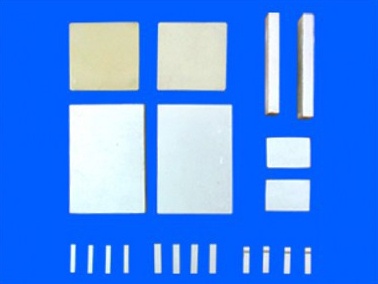
What Are PZT Piezoelectric Ceramic Components Used for in Industrial Devices?
PZT piezoelectric ceramic components sit inside a surprising range of industrial equipment. They are not always visible from the outside, but they often determine whether a device can sense tiny changes, generate controlled ultrasonic energy, or respond fast enough for precise measurement. In industrial environments where electrical signals need to become mechanical motion—or mechanical stress needs to become electrical output—PZT remains one of the most widely used material systems.
That broad use comes from the basic behavior of piezoelectric ceramics: they deform when voltage is applied, and they generate charge when mechanically stressed. PZT, short for lead zirconate titanate, is especially valued because it offers strong piezoelectric response, relatively mature processing routes, and good adaptability across sensors, actuators, transducers, and ultrasonic assemblies.
For engineers researching applications rather than shopping for a part number, the more useful question is not simply what PZT is, but where it makes sense in real equipment—and where performance depends heavily on design details such as geometry, resonance, polarization, drive conditions, and operating environment.
In practice, pzt piezoelectric ceramic components are often chosen when a device needs high sensitivity, compact size, fast response, or ultrasonic energy conversion that electromagnetic solutions cannot deliver as efficiently in the same footprint.
Where PZT shows up in industrial devices
Industrial use tends to fall into a few recurring functions: sensing, actuation, ultrasonic transmission, and precision measurement. The same ceramic family may serve very different roles depending on how it is shaped and integrated.
Ultrasonic welding, cleaning, and punching systems
One of the most established applications is high-power ultrasonic equipment. In welding, washing, drilling, or punching systems, PZT elements are built into transducers that convert electrical excitation into high-frequency mechanical vibration. That vibration is then amplified and directed into a horn, tool head, or liquid medium.
This matters because many industrial processes need concentrated energy in a small zone without conventional cutting or heating methods. Ultrasonic welding of plastics is a familiar example, but the same principle extends to cleaning tanks, material processing, and certain forms of precision punching. In these systems, the ceramic is not a passive material; it is the core energy-conversion element. If the ceramic stack is inconsistent, the entire transducer can drift in resonance, lose efficiency, or suffer from thermal stress.
Manufacturers with experience in power transducers often emphasize coherence and reliability for exactly this reason. In long-running industrial duty cycles, material consistency is not a marketing phrase; it affects amplitude stability, heating behavior, and service life.
Fault detection and non-destructive testing
PZT is also common in ultrasonic fault detection. Here, the goal is not to deliver power into a process, but to send and receive acoustic waves that reveal cracks, voids, bonding problems, or thickness variation inside a material or structure.
Sensitive ultrasonic inspection depends on signal quality. The piezoelectric element has to generate a controlled pulse and then detect weak reflected signals with minimal internal loss and acceptable bandwidth for the target inspection method. That is why the same broad category of ceramic can be optimized very differently for high-power cleaning equipment versus inspection probes.
In real projects, selection usually comes down to more than “high sensitivity.” Frequency range, matching layers, backing structure, impedance, and temperature conditions all change what works. A ceramic suitable for rugged shop-floor testing may not be ideal for a highly damped precision probe.
Flow meters and liquid monitoring
Another major use is in flow measurement. Ultrasonic flow meters commonly rely on piezoelectric transducers to send and receive acoustic signals through a fluid or pipe wall. The device then interprets timing differences, signal attenuation, or Doppler effects depending on the measurement principle.
PZT works well here because it can produce stable ultrasonic signals in compact formats. For industrial flow meters, that translates into non-intrusive measurement options, reduced pressure loss compared with some mechanical methods, and compatibility with systems where cleanliness or maintenance access matters.
Still, performance is never only about the ceramic. Pipe material, coupling method, fluid properties, and temperature range can all influence whether a given transducer design performs reliably. That is why application knowledge matters as much as material knowledge.
Length, displacement, and dimensional measurement
Some industrial devices use PZT in precision measurement tasks such as length measuring, displacement sensing, and fine positioning. In these cases, the ceramic may act as a sensor, an actuator, or both. A small deformation under voltage can be useful for micro-adjustment. The generated electrical signal under stress can support sensing tasks where response speed matters.
This dual capability is part of what makes piezoelectric ceramics so attractive in instrumentation. A well-designed assembly can react quickly and resolve very small changes, but the surrounding mechanical structure has to be engineered carefully. Mounting preload, stiffness, and environmental noise can affect usable accuracy more than many first-time buyers expect.
Oil well measurement and harsh industrial sensing
Oil field and downhole measurement are frequently mentioned in discussions about rugged piezoelectric applications. These environments are difficult: pressure, vibration, and temperature can all challenge the sensor assembly. PZT-based components may be used in acoustic measurement or pressure-related sensing functions, but suitability always depends on the complete package design, not just the ceramic itself.
This is a good example of a common misunderstanding. People sometimes assume the ceramic material alone defines field performance. In reality, electrodes, sealing, housing, cable connection, adhesive choices, and thermal management may decide whether the device survives real operating conditions.
Underwater acoustics and sonar
PZT is also widely used in underwater sound transmission and sonar-related devices. Waterborne acoustics require efficient conversion between electrical energy and sound waves, and piezoelectric ceramics are well suited to that role. Depending on the system, the element may transmit, receive, or alternate between both modes.
Industrial and marine uses can include ranging, detection, positioning, and acoustic communication functions. Here again, the ceramic is central, but the final result depends on encapsulation, acoustic matching, pressure resistance, and operating frequency.
Why industrial designers keep choosing PZT
There are other piezoelectric materials, and there are certainly non-piezoelectric ways to sense or actuate. Yet PZT stays relevant because it covers a useful middle ground: strong electromechanical response, broad design flexibility, and established manufacturing know-how.
For industrial devices, that usually means a few practical advantages:
- Fast response for dynamic sensing and actuation
- Compact form factors for embedded assemblies
- Efficient ultrasonic energy conversion
- Adaptability across high-frequency components, sensors, and power transducers
- Mature supply chain compared with more specialized alternatives
That does not mean it is effortless to use. Piezoelectric ceramics are brittle, parameter-sensitive, and closely tied to the mechanics of the final assembly. Good results depend on material control and application-specific design, not on selecting a generic ceramic disc and hoping the rest falls into place.
What engineers usually need to evaluate before choosing a component
When someone is early in the research stage, they often focus on the application name—flow meter, welding head, sensor probe, sonar element. Suppliers and design teams usually have to look one level deeper. A few questions determine whether the component will fit the device:
- Is the part mainly transmitting energy, receiving signals, or doing both?
- What frequency range and resonance behavior are required?
- Will the device run continuously, intermittently, or in short pulses?
- What are the temperature, humidity, pressure, and chemical exposure conditions?
- How tightly does the finished assembly need to control sensitivity, output, or consistency?
These questions are more useful than chasing a single “best” material grade in the abstract. For example, a ceramic intended for powerful ultrasonic welding may prioritize robust transduction under load, while a ceramic for sensitive detection may need different balance between response and damping. The same supplier can support both, but not with the same part design by default.
Why manufacturing consistency matters more than many buyers expect
In industrial procurement, people sometimes compare piezoelectric components only by drawings and nominal electrical values. That can be risky. For PZT parts used in transducers or sensor arrays, repeatability from batch to batch affects tuning, calibration workload, and field stability.
This is one reason established manufacturers remain important in the sector. Weifang Jude Electronic Co. Ltd, for example, works as a manufacturer and supplier of piezoelectric ceramics used across electrical and ultrasonic functions, including piezoelectric components, piezoelectric ceramic sensors, ultrasonic piezo products, and power transducers. The applications associated with such production capabilities—high-frequency components, ultrasonic welding, washing, punching, fault detection, length measuring, oil well measurement, flow meters, underwater sound, and sonar—reflect how wide the industrial demand really is.
That breadth is relevant for readers because suppliers serving multiple application classes usually learn where material behavior changes under different drive levels and packaging constraints. For an engineering team, that experience can be as valuable as the base material itself, especially when a device has to move from lab validation into stable production.
A few misconceptions worth clearing up
Not every industrial problem involving vibration or sensing calls for PZT. If the required displacement is large and low-frequency, another actuator type may fit better. If environmental regulations, export requirements, or end-market restrictions apply, material compliance details should be checked early rather than assumed. And if the application will face extreme temperatures, standard piezoelectric behavior may shift enough that design margins need careful review.
Another mistake is treating the ceramic as a stand-alone commodity. In many devices, the usable performance comes from the interaction between the ceramic, electrode design, backing, housing, preload, bonding method, and driving electronics. That is why two assemblies built around nominally similar PZT pieces can behave very differently in the field.
What to take away
PZT piezoelectric ceramic components are used in industrial devices wherever precise electromechanical conversion is needed: ultrasonic welding systems, cleaning equipment, punching tools, fault detection instruments, flow meters, dimensional measurement devices, oil well measurement systems, and underwater acoustic equipment are all common examples.
Their value is not just that they are piezoelectric. It is that they can be engineered into highly specific roles, from high-power ultrasonic output to delicate signal reception. The right choice usually depends on application conditions, frequency behavior, packaging, and manufacturing consistency far more than on a generic material label.
If you are evaluating a device concept or reviewing an existing design, the most practical next step is to confirm the operating mode, environment, target frequency, and integration constraints before narrowing down the component. With piezoelectric ceramics, those details are where performance is decided.

Thank you very much for writing to us. Please leave your message and contact information, we will reply to you within 24 hours.