

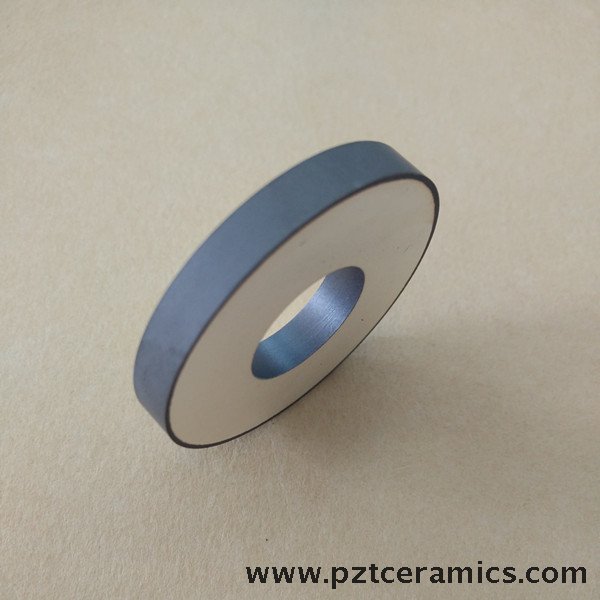
Hard PZT is usually the stronger starting point for sustained, high-power operation near resonance. Soft PZT is often a better candidate when displacement per volt or charge response matters more than continuous power handling. For engineers selecting PZT piezoelectric ceramic components, that distinction provides a useful first screen, but the final choice depends on drive level, duty cycle, bandwidth, temperature, and the electrical interface.
A high piezoelectric coefficient alone cannot establish which material will perform better. A sensitive receiver may benefit from a lower dielectric permittivity, while a pulsed ultrasonic transducer may need enough damping to stop ringing quickly. Likewise, a hard ceramic with favorable low-signal properties still needs validation at the vibration amplitude and temperature expected in service.
What the hard–soft distinction changes
The terms “hard” and “soft” describe the electrical and mechanical response associated with the ceramic formulation and domain behavior; they do not describe ordinary surface hardness. Hard PZT formulations generally restrict domain-wall motion more strongly. Soft formulations allow a greater domain contribution to the response, producing higher piezoelectric coefficients but also greater susceptibility to losses and nonlinear behavior under some operating conditions.
These tendencies create several useful selection signals:
- Piezoelectric coefficient, d: Soft PZT generally provides greater strain per applied electric field or greater charge per applied force, with the relevant coefficient determined by the loading and poling directions.
- Mechanical quality factor, Qm: Hard PZT generally has a higher Qm, indicating lower mechanical energy loss relative to stored energy in the measured vibration mode.
- Dielectric loss: Hard formulations generally offer lower dielectric loss, an advantage when repeated electrical excitation would otherwise generate significant heat.
- Dielectric permittivity: Soft PZT often has higher permittivity, increasing component capacitance for a given geometry.
These are formulation trends, not acceptance limits. Two materials within the same family can differ enough to change a design decision. Property values also depend on measurement conditions, temperature, vibration mode, and drive amplitude. A comparison becomes useful only when those conditions are reasonably aligned.
For power ultrasound, compare usable output and heat together
Ultrasonic welding and sustained ultrasonic cleaning place repeated mechanical and electrical demands on the ceramic. In these applications, hard PZT is a logical starting point because lower losses can support useful vibration output with less internal heating. Its higher mechanical quality factor also supports efficient resonant operation.
The qualification is that a material’s small-signal Qm does not establish the power capability of a finished transducer. High-amplitude operation can change loss, resonance, and temperature behavior. The assembly introduces additional losses through joints, interfaces, preload, mounting, and the acoustic load. A ceramic with an attractive datasheet can therefore deliver disappointing performance if the assembled system dissipates too much energy or concentrates stress locally.
Evaluate candidate materials at the required output: vibration velocity, displacement, acoustic output, or another application-specific measure. Comparing only at equal voltage can be misleading because the materials may produce different motion and draw different current. The useful question is how much electrical input and temperature rise each candidate requires to deliver the intended output under the same load.
Duty cycle can change the outcome. A short excitation burst with adequate cooling time may tolerate losses that would be unacceptable during continuous operation. Soft PZT can therefore remain a candidate for some pulsed transmitters, particularly where strong excitation at a limited voltage is valuable. That choice still requires checks for peak electric field, mechanical stress, transient heating, and depolarization risk.
High Q also brings a system trade-off: a sharply resonant assembly can be more sensitive to frequency shifts and may ring for longer after excitation. Welding equipment can benefit from sustained resonance, while a pulse-echo instrument may need the transmitter to settle quickly enough to detect nearby echoes. Loading, backing, matching layers, and drive control all influence the final behavior; ceramic Qm alone does not determine assembled bandwidth.
For sensing and actuation, define what “sensitivity” means
Soft PZT is attractive when the objective is greater charge output under force or greater displacement for a given voltage. This makes it a natural candidate for many sensors and actuators. However, a receiver’s useful sensitivity also depends on capacitance, readout electronics, operating frequency, and noise.
For a force input aligned with the relevant material axis, the piezoelectric charge coefficient helps describe the generated charge. In a voltage readout, the voltage coefficient also matters. The relationship is commonly expressed as g = d/ε, using the corresponding piezoelectric coefficient and dielectric permittivity. A larger d can be accompanied by a larger ε, so the material with the highest charge response does not automatically provide the highest open-circuit voltage response.
This distinction affects practical evaluation. A charge amplifier emphasizes charge generation, although sensor capacitance still affects noise and circuit design. A high-impedance voltage input makes sensor capacitance, cable capacitance, and leakage particularly relevant. For weak signals, compare the complete receiver’s signal-to-noise performance across the required frequency band. Ranking ceramics by d alone leaves too much of the measurement chain unexamined.
Ultrasonic flaw detection illustrates the competing demands. Strong transmission helps create a usable echo, but prolonged ringing can obscure early returns. Greater material response may be valuable, yet the preferred formulation must work with the backing, acoustic matching, pulse waveform, and receive circuit. A transmit-receive element may require a compromise that would be unnecessary in a dedicated transmitter or receiver.
For actuators, soft PZT can help achieve displacement within a limited voltage budget. Higher permittivity, however, increases capacitance for the same geometry. At a given frequency and voltage, that generally increases the current the driver must supply. Dielectric losses also contribute to heating during repeated cycling. Stroke, driver capacity, thermal behavior, hysteresis, and creep should therefore be evaluated together when positioning accuracy or rapid motion matters.
Turn the material comparison into a qualification decision
Start with the constraint most likely to make the design fail. For a continuously driven welding transducer, that may be temperature rise at the required vibration output. For a receiver, it may be noise or inadequate bandwidth. For an actuator, it may be insufficient displacement within the available voltage and current. This gives the material comparison a measurable purpose.
Request a compact set of relevant properties rather than collecting every available datasheet number:
- Properties for the intended mode: Relevant piezoelectric and coupling coefficients, dielectric permittivity, mechanical quality factor, and elastic properties.
- Losses under meaningful conditions: Dielectric and mechanical loss behavior at representative frequency, drive amplitude, and temperature.
- Operating boundaries: Recommended electric field, stress, and temperature limits, with the duty cycle and mounting assumptions identified.
- Component consistency: Tolerances on dimensions, capacitance, and resonance, plus controls relevant to electrodes, poling, and repeatability between batches.
Curie temperature deserves particular care. It is a material transition temperature, not a recommended continuous operating temperature. Practical limits can be substantially lower and depend on formulation, electrical excitation, stress, and exposure time. Use the supplier’s applicable operating guidance and verify the thermal margin in the assembly, including internal heating.
Prototype comparisons should preserve the intended geometry, preload, mounting, and acoustic load wherever possible. Record electrical input, useful output, resonance behavior, and temperature over the actual operating cycle. For receivers, include noise and recovery after transmission; for actuators, include displacement under load and drift over time. Recheck relevant properties after exposure to identify changes that an initial performance measurement would miss.
Choose hard PZT when it meets the output requirement with a convincing loss and thermal margin. Choose soft PZT when its greater response provides a measurable advantage within the driver, bandwidth, and stability constraints. If both pass, prefer the formulation that preserves more margin against the application’s limiting condition. That margin is a stronger basis for selection than the largest coefficient on a datasheet.

Thank you very much for writing to us. Please leave your message and contact information, we will reply to you within 24 hours.