

Selecting High-Power PZT Ceramics for Continuous vs. Pulsed Operation
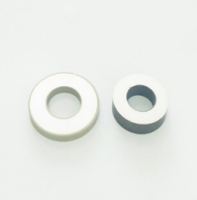
Selecting high power piezoelectric ceramic components starts with the drive conditions: continuous operation usually makes heat removal and stability the main constraints, while pulsed operation adds limits on peak electric field, transient stress, and response time. A ceramic that performs well under steady excitation may build vibration too slowly for a short burst. Another may respond quickly but generate excessive heat during sustained operation.
Hard PZT is often the starting point for resonant power transducers because of its relatively low losses and resistance to depolarization. However, choosing the highest mechanical quality factor or a familiar material designation is insufficient. The material must suit the operating frequency, vibration mode, waveform, mounting arrangement, and thermal environment.
Define the operating cycle before comparing materials
“Continuous” and “pulsed” describe timing, but they do not fully describe ceramic loading. An ultrasonic welding system may deliver short bursts repeatedly enough for heat to accumulate. A sonar transmitter may have a low duty cycle yet expose its ceramic to substantial electric field and mechanical stress during each transmission.
Build a drive specification that includes:
- Operating frequency, vibration mode, and expected resonance tracking range.
- Voltage waveform, peak and RMS voltage, any DC bias, and ceramic thickness.
- Pulse duration, repetition rate, burst spacing, and longest uninterrupted operating period.
- Required displacement, vibration velocity, acoustic output, or delivered mechanical power.
- Ambient conditions, cooling path, mechanical preload, and load variation.
For simple repeated bursts, duty cycle is the energized time divided by the total cycle time. It helps estimate average heating, but it does not establish a safe peak drive level. Two systems with the same duty cycle can have different temperature excursions and fatigue behavior if their burst lengths and cooling intervals differ.
For continuous operation, evaluate losses at the working amplitude
Continuous ultrasonic cleaning and other sustained power applications require a thermal balance: heat generated within the ceramic and assembly must escape quickly enough to keep operation stable. Both electrical and mechanical losses contribute.
Dielectric loss converts part of the electrical input into heat. Under approximately sinusoidal excitation, this heating depends on frequency, capacitance, RMS voltage squared, and dielectric loss tangent. A low loss tangent is therefore useful, but the value on a datasheet is often measured under small-signal conditions. It may not represent behavior at the intended field and temperature.
Mechanical quality factor, Qm, describes losses associated with vibration. Higher Qm generally indicates lower mechanical dissipation in the measured mode, making it a useful screening property for sustained resonant operation. However, a small-signal Qm measurement does not establish how a ceramic behaves at high vibration velocity. Losses can increase with amplitude, and the assembled transducer also loses energy through joints, electrodes, mounting, and the load.
Compare candidate materials at a common, application-relevant output. A comparison at equal voltage may be misleading because different ceramics can produce different vibration amplitudes. Temperature rise and electrical input at the required output provide a more useful basis for selection.
Temperature also changes resonance and electrical impedance. If the drive cannot follow these changes appropriately, delivered output may fall or electrical loading may increase. Material selection, cooling, and generator control therefore need to be evaluated together.
Pulsed operation needs separate peak and timing checks
Reduced average heating can permit stronger excitation during a burst, but it does not remove instantaneous failure limits. Assess peak electric field, peak stress, and the time needed to establish useful vibration independently.
Peak field and stress can limit a cold ceramic
Applied voltage must be translated into electric field using the active ceramic thickness and electrode configuration. Terminal voltage alone is an inadequate comparison, particularly between monolithic rings, plates, and multilayer components. Reverse field relative to the poling direction can contribute to depolarization, with susceptibility affected by temperature and material composition.
Electrical breakdown and depolarization are different limits. A ceramic can lose useful polarization without suffering visible dielectric breakdown. Neither limit should be inferred directly from a coercive-field value measured under different conditions.
Mechanical loading also matters because PZT is brittle and vulnerable to tensile stress. In a bolt-clamped transducer, preload helps control tensile loading during vibration. Too little preload can allow interface separation; excessive or uneven preload can damage the ceramic or alter its behavior. Peak dynamic stress must be assessed within the assembled structure, including local stress concentrations.
High Q can conflict with short bursts
A high-Q resonator stores vibration energy efficiently, but takes time to build amplitude and continues vibrating after excitation stops. If a pulse is short relative to this buildup time, the transducer may never reach its expected steady-state output.
For pulse-echo sonar, continued vibration can also interfere with receiving nearby echoes. A lower loaded Q, suitable backing, or electrical damping may improve response time, although these choices can reduce efficiency or increase drive requirements. The relevant quantity is the behavior of the complete transducer under load; ceramic Qm alone does not predict pulse response.
Use material properties as a shortlist, not a ranking
Hard PZT formulations commonly suit resonant power applications, while softer formulations often offer greater piezoelectric response but higher losses under demanding drive conditions. This makes hard PZT a reasonable starting point for sustained ultrasonic power. It does not make every hard grade interchangeable or exclude other formulations from pulse applications.
Coupling coefficient indicates how effectively electrical and mechanical behavior interact in a particular mode. Use the coefficient relevant to the intended geometry and vibration mode. A high thickness-mode coupling value does not establish suitability for a radial-mode device. Likewise, a higher piezoelectric coefficient may increase displacement per unit field without providing the best efficiency or stability at the required output.
Common labels such as PZT-4 and PZT-8 help identify material families, but supplier formulations and measurement conditions can differ. Compare actual property data and operating behavior instead of treating the designation as a complete specification.
Curie temperature is also an incomplete guide. It describes a material transition, not a recommended continuous service temperature. Practical limits may be lower because of depolarization, changing losses, electrode systems, adhesives, or assembly stresses.
Request data that supports an operating decision
A useful supplier discussion connects material properties with a defined component and drive profile. Request the following information for shortlisted grades:
- Measurement conditions: frequency, temperature, vibration mode, and excitation level for quoted properties.
- Behavior under substantial drive: available loss, impedance, resonance, and temperature-rise data near the intended field or vibration amplitude.
- Operating limits: field polarity, temperature, stress, and the conditions underlying any recommended limits.
- Component consistency: tolerances for dimensions, capacitance, resonance, electrodes, and polarization orientation.
Weifang Jude Electronic Co. Ltd supplies piezoelectric ceramics and power transducers for applications including ultrasonic welding, cleaning, and underwater acoustics. When discussing a candidate component, provide the operating cycle and assembly requirements so the quotation can address a relevant material and geometry.
Validate the ceramic in the complete assembly
For continuous duty, run the assembled transducer at the required output until its thermal behavior is clear. Track temperature, resonance, impedance, and delivered output under representative loading and cooling conditions. Surface temperature alone may miss hotter regions inside the assembly.
For pulsed duty, measure burst buildup, ring-down, peak voltage and current, and temperature accumulation over repeated cycles. Include startup, shutdown, and expected load changes, since these can create conditions absent during stable operation.
Select the grade that meets output and response requirements with acceptable heating and electrical and mechanical margins. Approve it against a documented drive envelope: waveform, frequency range, burst timing, load, cooling, and preload. That gives future component substitutions and operating changes a clear basis for comparison.

Thank you very much for writing to us. Please leave your message and contact information, we will reply to you within 24 hours.